


HEINXS | A New Wave of Innovation and Breakthrough
Industry Development Trends
The industry level continues to improve, gradually moving toward MEMS-based, intelligent, networked and systematic development.
Industry Development History

China's sensor industry can be traced back to the 1950s. With the widespread application of structural and solid-state sensors, sensor technology was listed as a key research project in the "Seventh Five-Year Plan" in 1986, marking the start of the substantive development stage of sensor research. With the nation's continuous support, sensor technology has improved significantly, and a fairly complete industrial chain has now taken shape. In particular, in recent years, sensors — as an important part of the Internet of Things — have been elevated to a new height, with their market position becoming increasingly prominent.
Industrial Chain Analysis
Upstream raw materials are in abundant supply. From the perspective of the sensor industry chain, the upstream mainly covers the key raw materials required for sensor manufacturing, including semiconductor materials, ceramic materials, metal materials and more. These raw material suppliers play a key role in the industrial chain, providing the necessary material foundation for midstream sensor manufacturing. Intelligent development in downstream industries drives sensor demand growth. The midstream is the sensor manufacturing stage, while the downstream covers the main application fields of sensors — mainly industrial electronics, automotive electronics, communication electronics and consumer electronics. In these fields, sensors are widely applied, providing important technical support for the intelligentization and automation of various industries.

Technology Continuously Iterates and Localization Rate Rises Significantly
Technology keeps iterating and updating, and the localization rate has increased significantly. Rapid economic development has driven demand for sensors in fields such as intelligent manufacturing, the Internet of Things and automotive, prompting continuous innovation in sensor technology. As of February 19, 2024, the number of sensor patent applications had reached 6,000. Looking at China's intelligent sensor localization rate, it stood at 13% in 2016, growing to 31% by 2020, a compound growth rate of 24%. According to data from the China Electronic Components Industry Association, the localization rate of intelligent sensors in China exceeded 75% in 2022, a significant improvement over previous years.


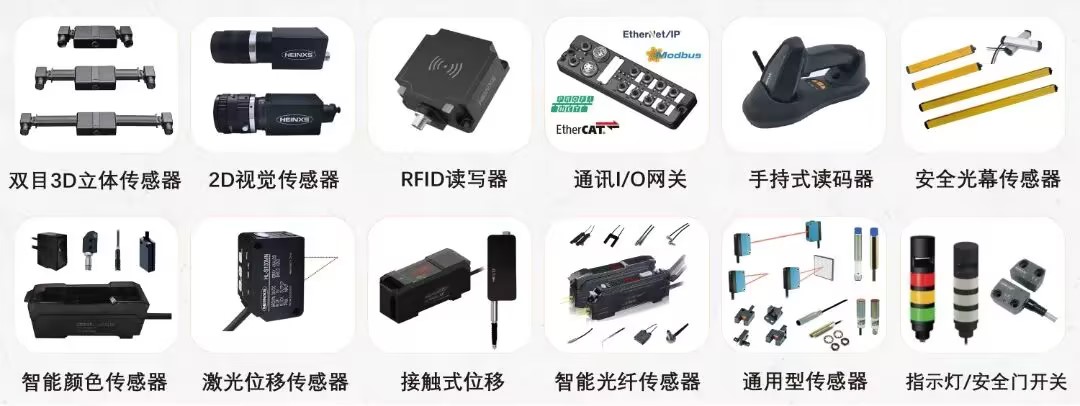
The sensor industry has broad development prospects. In the future, upstream-downstream collaboration in the industrial chain will become closer: upstream innovation drives midstream development, and downstream demand drives the industrial chain. HEINXS will continue to optimize its product structure, increase R&D investment, expand market space, and enable sensor technology to be widely applied in more fields.