


Knowledge Sharing | RFID Readers in the Internet of Things
What is an RFID Reader?
An RFID reader (Radio Frequency Identification) is also called an "RFID reader" — radio frequency identification technology that automatically identifies target objects and obtains relevant data through radio frequency signals without manual intervention. It can identify high-speed moving objects and multiple RFID tags simultaneously, with fast and convenient operation.

RFID technology is applied in many industries, such as logistics and warehousing management, anti-counterfeiting traceability, industrial manufacturing, ETC, etc. Especially after the concept of Industry 4.0 was proposed, RFID readers have been widely used in manufacturing.
RFID Readers in IoT Applications
In the Internet of Things, the RFID electronic tag carried by an object is equivalent to giving the object a virtual "identity" on the network. By reading the information on RFID tags through an RFID reader, the attributes, characteristics and other information of the tagged items can be queried and dynamically tracked in real time on the network.

The Internet of Things can realize global item tracking and information sharing, greatly improving management and operation efficiency and reducing costs, bringing deep changes to every link of the global supply chain (warehousing logistics, production manufacturing, item tracking, commercial retail, public services and other industries). To achieve this, the RFID reader is indispensable — only with it can RFID tag information be collected "anytime, anywhere", realizing seamless and comprehensive IoT coverage.

As an indispensable part of the RFID system, the RFID reader can be further divided into RFID antenna and RFID reader. The RFID reader transmits signals through the RFID antenna to "wake up" and send commands to RFID electronic tags, and receives the signals returned by the tags. After preliminary filtering and signal processing, the RFID tag information is acquired and parsed, and useful data is exchanged through the network and data management system. The data management system can be simple local software, or distributed ERP management software integrated with RFID management modules.

Composition of an RFID Reader
An RFID reader generally consists of an RF module, a control processing module and an antenna. The RF module is mainly responsible for the conversion between RF signals and baseband signals and the modulation/demodulation of data information; the control processing module, as the core of the RFID reader, is mainly responsible for communication management with the platform system and RFID tags, encoding/decoding of baseband signals, executing anti-collision algorithms, encryption/decryption during data transmission, identity authentication, and control of peripherals; the antenna is mainly responsible for receiving or sending RF signals to realize the transmission of data information and energy.

Functions of an RFID Reader
1
Responsible for communication with RFID electronic tags: initializing tags, reading/writing data information in tags, and managing tags (e.g., disabling their functions);
2
Responsible for communication with the computer platform system: on one hand, transmitting data read from RFID tags to the platform; on the other hand, receiving control information from the platform system to complete specific application actions;
3
Transmitting energy to passive RFID tags via radio frequency; for active tags, it can also read related information of the tag's built-in battery, such as remaining power.
4
RFID readers are easy to install and can generally be managed and controlled by application software, enabling remote maintenance;
5
RFID readers have the ability to recognize multiple tags with anti-collision, can identify multiple moving tags, complete simultaneous access of multiple tags, and possess information anti-collision capability for reading multiple tags at once;
6
RFID readers have strong compatibility with the most common communication protocols and can communicate with a variety of electronic tags.

Structure and Form of RFID Readers
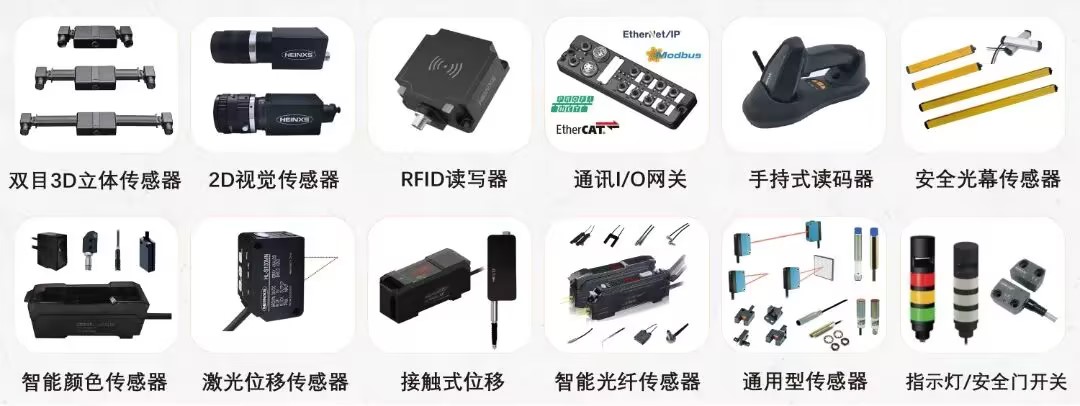
The structure of RFID readers has no fixed form; it is mainly designed according to needs and application scenarios. HEINXS readers mainly include the HR18 series HF RFID readers, HR30 series HF RFID readers, HRF1 series HF RFID readers, HRH-UHF handheld data collection terminals, and more.

For more RFID-related information, please call 400-0609-369 anytime. We look forward to your inquiries and cooperation.